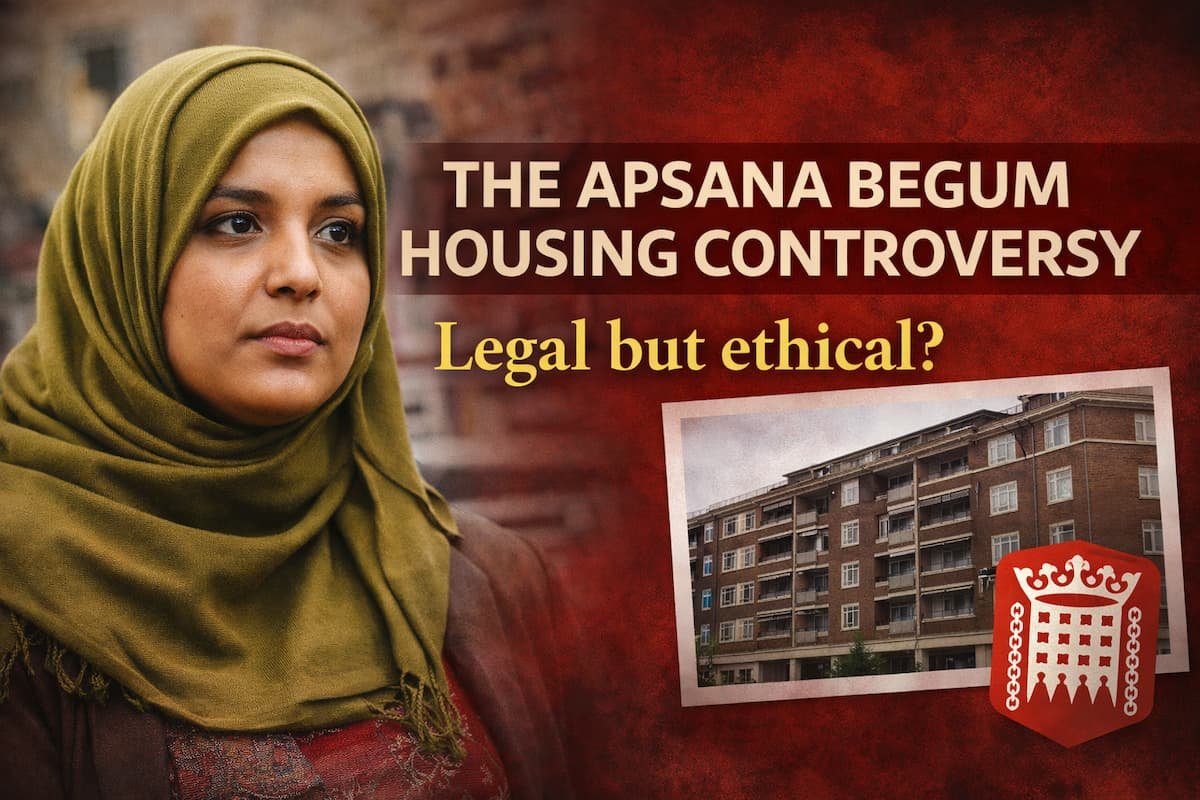
When Legal Is Not the Same as Fair The Apsana Begum Housing Controversy
February 01, 2026
The case of Labour MP Apsana Begum has reopened an uncomfortable debate in British politics: where does legality end and ethical responsibility begin? Her decision to continue living in a council flat while earning a parliamentary salary has become a lightning rod for criticism, not because it is unlawful, but because it exposes deep contradictions in how public housing is perceived and used.
Council housing exists to support people who cannot realistically compete in the private market. In many parts of London, waiting lists stretch for years. Families live in overcrowded conditions, while others are placed in temporary accommodation far from work and school. Against this backdrop, the idea that an MP earning close to six figures still occupies social housing feels, to many, symbolically wrong — even if technically permitted.
Begum’s defenders argue that she followed the rules. She did not illegally obtain the flat, and no regulation forces her to move out once her income rises. From a purely legal standpoint, this argument is sound. Social housing policy often lacks mechanisms to reassess eligibility after a tenant’s circumstances change. In that sense, the controversy exposes a flaw in the system rather than personal misconduct.
Yet politics is not judged only by law. It is judged by perception, consistency, and trust. Begum has been a vocal critic of housing inequality and shortages. That makes her personal housing situation more politically sensitive than that of an ordinary tenant. When a politician campaigns on fairness and access while benefiting from a scarce public resource, critics see hypocrisy, even if no rules are broken.
This is why the issue resonates beyond one individual. It highlights a structural problem: social housing is treated as a lifetime entitlement rather than a flexible safety net. If eligibility is never reviewed, the system risks becoming frozen, locking out those who are in greater need today. The result is not justice, but stagnation.
There is also a wider cultural tension at play. In the UK, council housing once served a broad segment of society, including working professionals. Over time, it has become associated almost exclusively with poverty and crisis. That shift makes cases like this politically explosive. What might once have been unremarkable now appears as misuse.
Ultimately, this controversy is less about Apsana Begum and more about what public office demands. Elected officials operate under a higher moral microscope. They are not only expected to obey the law, but to embody the values they promote. Whether or not Begum chooses to leave her flat, the damage is already political: the story reinforces public cynicism about politicians living by different standards than the people they represent.
The lesson is clear. Housing policy needs reform that reflects changing circumstances, not permanent status. And politicians must understand that transparency and consistency matter as much as legality. When resources are limited, ethics becomes part of governance — not an optional extra.