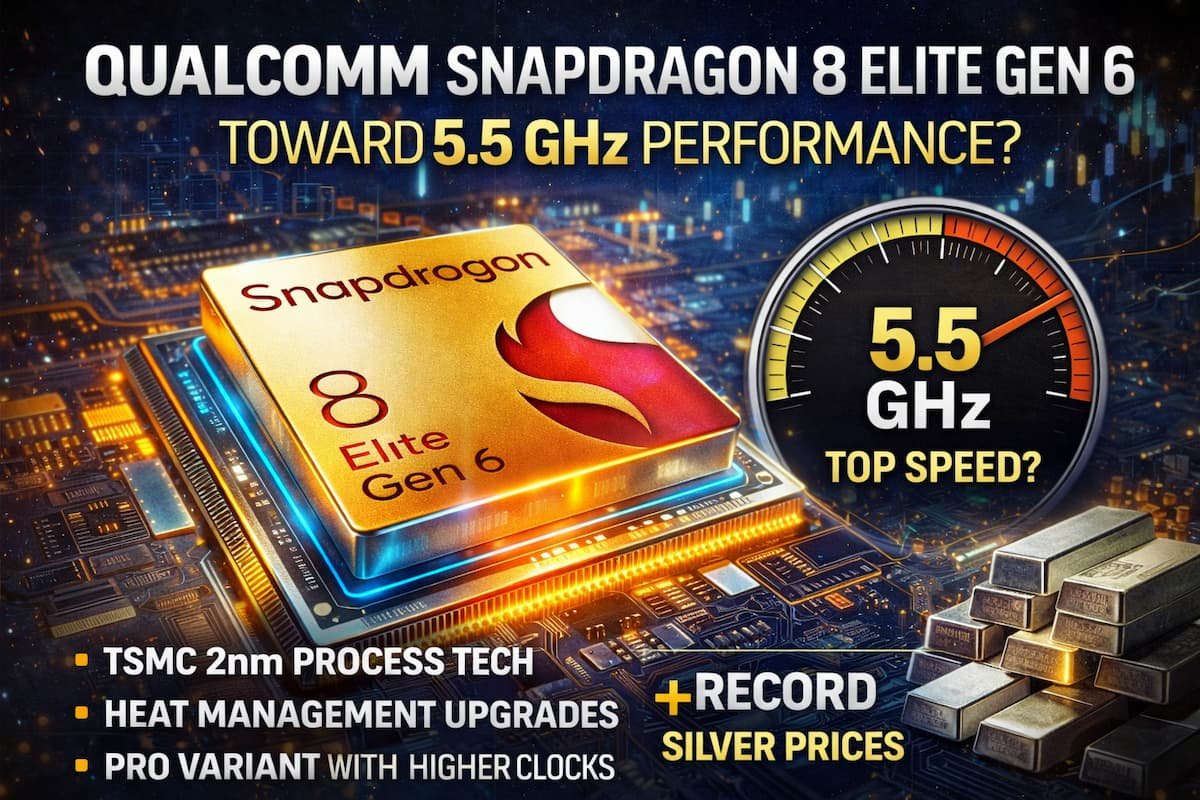
Qualcomm Snapdragon 8 Elite Gen 6: Toward 5.5 GHz Mobile Performance?
January 27, 2026
The next flagship mobile chipset from Qualcomm, Snapdragon 8 Elite Gen 6, is shaping up to be one of the most ambitious upgrades in recent years — according to new leaks and industry reports. While official specifications have not been released, multiple credible sources suggest Qualcomm is targeting clock speeds above the 5 GHz barrier, new cooling technology, and cutting-edge manufacturing that could redefine smartphone performance.
Breaking the 5 GHz Barrier
In early leaks shared by industry insiders on social media, engineering samples of the Snapdragon 8 Elite Gen 6 have reportedly reached 5 GHz in testing, with a theoretical upper ceiling between 5.5 GHz and 6.0 GHz — a dramatic jump from the current Snapdragon 8 Elite Gen 5’s approximate 4.61 GHz peak.
This type of frequency milestone — previously typical only for desktop processors — would mark a significant shift in mobile chip performance expectations. Achieving sustained performance at such clock rates, however, depends heavily on thermal management and power efficiency.
Two Variants: Standard and Pro
Most leaks indicate Qualcomm plans a dual-variant strategy for the Gen 6 series:
- A standard model aimed at premium flagship smartphones, and
- A Pro version designed to push higher clock speeds and possibly power sustained performance closer to desktop levels.
This mirrors trends in the industry where chipset makers offer tiered silicon options to balance performance, power, and cost across device segments.
Advanced Cooling Solutions
To address increased heat output at higher frequencies, Qualcomm’s next flagship may integrate advanced thermal technologies. Leaks suggest the use of Heat Pass Block (HBP) solutions — originally developed by Samsung — which embed efficient heat dissipation directly into the chip package.
Improved cooling could allow the chip to operate at peak speeds for longer periods without throttling, which is crucial for intensive tasks like sustained gaming or AI workloads.
2 nm Manufacturing and Efficiency Gains
Another major component of the Gen 6 story is the reported use of TSMC’s 2 nm N2P process node. This shift from the current 3 nm class used in the 8 Elite Gen 5 would potentially improve both energy efficiency and performance density — key for enabling higher clock speeds without disproportionate battery drain.
However, the industry remains cautious; cutting-edge process nodes often face yield and manufacturing challenges before mass adoption. As such, final commercial performance may differ from early engineering results.
Implications for Smartphone Performance
If these rumors materialize, Snapdragon 8 Elite Gen 6 could close the gap between mobile and traditional desktop performance — particularly in single-threaded tasks that benefit directly from higher frequencies.
By combining high clock speeds, next-gen process technology, and improved thermal architecture, Qualcomm may deliver a new performance tier for Android flagships in late 2026 and beyond.
Yet, early hype should be balanced against reality: leaks don’t always match final products, and real-world sustained performance depends on device cooling, battery constraints, and software optimization.